Enquiry
Road Earthwork Contractor in Navi Mumbai
A finished road looks simple.
There is a smooth surface, clear alignment and traffic moving from one destination to another. But stand on the same site at the beginning of construction and the picture can be completely different.
There may be uneven ground, excavated material, changing levels and heavy machinery moving continuously across the site. Before the visible road can be built, the land itself has to be prepared for it.
That is where road earthwork begins.
At Godavari Constructions, we have spent decades working on the civil activities that happen at this stage. Our roots in civil contracting go back to 1978, while Godavari Constructions was established in 1989.
Through our work across road, highway, expressway and other infrastructure projects, we have learned that successful road construction starts with one fundamental requirement: getting the ground ready.
Turning an Alignment Into a Road Formation
A road alignment on a drawing is precise.
The actual land rarely is.
Along the route, existing ground levels may rise and fall. Some locations can require excavation, while others may need filling and embankment development to achieve the required formation.
Road earthwork is the process of gradually bringing these conditions closer to what the project requires.
Depending on the scope, this can involve excavation, loading, transportation, filling, grading, compaction, embankment development and sub-grade preparation.
None of these activities exists in isolation.
Together, they create the groundwork on which subsequent road construction can progress.
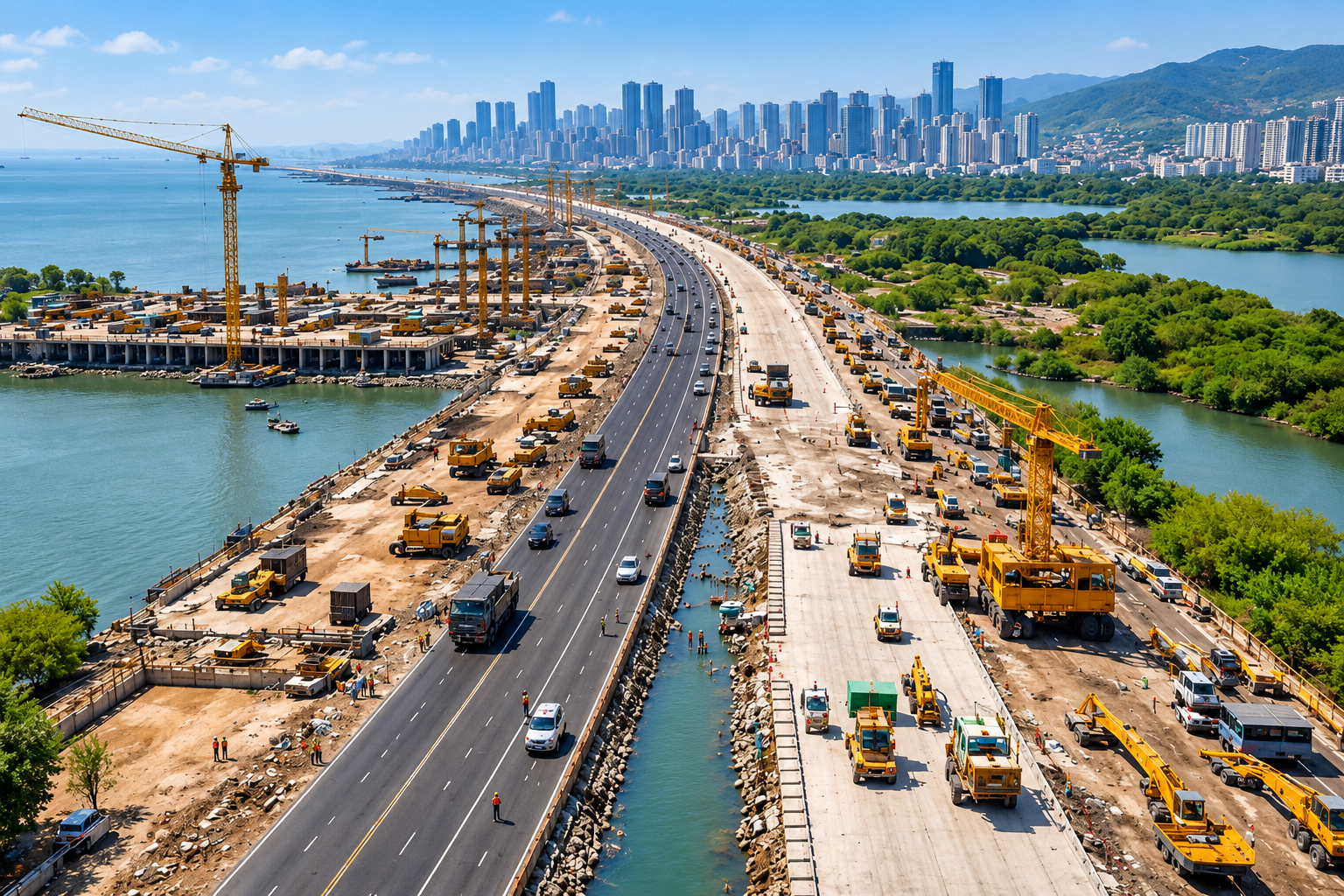
A Day on an Earthwork Site Is About Movement
Road earthwork is constantly moving.
Excavators are working at cutting locations. Tippers are travelling between loading and unloading points. Material is being placed elsewhere along the alignment. Graders and rollers may be operating on sections that have reached a later stage.
This movement has to remain coordinated.
If excavation continues without adequate transportation, material can accumulate. If too many vehicles arrive at one unloading location, the area can become congested. If formation preparation does not keep pace with filling activities, subsequent work may have to wait.
For us, this is one of the most practical lessons of earthwork: productivity depends on the complete cycle, not one machine.
Our Road Earthwork Experience
Our approach has developed through practical involvement in major infrastructure projects.
Godavari Constructions' documented portfolio includes work associated with NH-166 Ratnagiri–Kolhapur, involving earthwork, excavation, embankment and sub-grade activities.
Our experience also includes work associated with the Mumbai–Nagpur Expressway, including a section between Km 498.000 and Km 501.400.
Working on road and expressway infrastructure has given our teams exposure to the challenges of managing civil activities across extended construction stretches.
That experience is particularly relevant to our role as a road earthwork contractor in Navi Mumbai, where growing infrastructure continues to create complex construction and material-movement requirements.
Cutting the High Ground, Building the Low Ground
One of the most interesting things about road earthwork is how much the original landscape can change.
Where the existing ground is above the required formation, excavation may be necessary.
Where it is below the required level, filling and embankment development may be required.
In practical terms, this means a road earthwork operation can involve both taking material away and building the formation up.
Managing these activities requires an understanding of quantities, machinery requirements, material movement and the sequence in which different sections of the road need to progress.
The objective is not simply to move earth.
It is to shape the ground according to the requirements of the road.
Material Has to Keep Moving
Once earth is excavated, it has to go somewhere.
This makes transportation an important part of road earthwork.
Our experience includes substantial material loading and transportation activities, including work related to Navi Mumbai International Airport.
On road projects, transportation needs to work closely with excavation and placement operations.
The distance between loading and unloading locations, site access and availability of equipment can all influence how efficiently material moves.
When quantities become large, managing this movement becomes a major operation in itself.
The Machinery Behind the Formation
Different stages of road earthwork require different equipment.
Our machinery resources include Poclain excavators, Tata Hyva tippers, graders, vibratory rollers, water tankers and tractor loaders, together with supporting vehicles and equipment.
Excavators support cutting, excavation and loading.
Tippers keep material moving.
Graders help develop the required levels and formation.
Vibratory rollers support compaction activities.
The value of this equipment comes from using it as a coordinated fleet rather than treating each machine as an independent resource.
On a busy earthwork site, timing matters almost as much as machinery.
Experience Matters When Conditions Change
No road project exists only on paper.
Once construction begins, teams work with actual terrain, actual access conditions and the practical realities of operating heavy machinery across the site.
Conditions can also vary from one section of an alignment to another.
This is where experience becomes useful.
Our project history across Navi Mumbai, Raigad, Ratnagiri, Kolhapur and other locations in Maharashtra has exposed our teams to different construction environments.
Over the years, we have learned to look at what the site is telling us and coordinate our resources accordingly.
Navi Mumbai and the Need for Strong Road Infrastructure
Navi Mumbai continues to develop as a major urban, commercial, industrial and transportation region.
As different parts of the region grow, road connectivity remains an essential part of supporting that development.
Our experience in and around Navi Mumbai includes work associated with CIDCO as well as material transportation related to Navi Mumbai International Airport.
For us, working as a road earthwork contractor in Navi Mumbai means contributing at the stage where future road infrastructure first begins taking physical shape.
The finished road may eventually become part of everyday life.
The earthwork underneath it begins much earlier.
People Keep the Machines Productive
Road earthwork may be machinery-intensive, but the operation depends heavily on the people managing it.
Our workforce includes project managers, site engineers, supervisors, equipment operators, drivers, helpers and supporting personnel.
Every role connects with another.
An operator can excavate efficiently only if transportation is available. Drivers need clear movement routes and unloading locations. Supervisors coordinate daily operations, while engineers and project managers keep activities aligned with broader project requirements.
When the site team works as one operation, machinery can be used more effectively.
What Should You Look for in a Road Earthwork Contractor?
For a large road project, selecting a contractor should involve more than checking whether excavators and tippers are available.
Relevant road and infrastructure experience matters.
The contractor should understand excavation, material movement, embankment formation, grading and sub-grade-related activities. There should also be sufficient manpower to coordinate machinery and work across different sections of the project.
Most importantly, the contractor should understand how these activities connect.
At Godavari Constructions, that understanding has developed through decades of civil contracting and practical infrastructure work.
Looking for a Road Earthwork Contractor in Navi Mumbai?
Our civil contracting journey began in 1978, with Godavari Constructions established in 1989.
Since then, our work across highways, expressways, railway formation, airport-related material movement, irrigation and other civil infrastructure assignments has strengthened our ability to undertake demanding groundwork.
For projects requiring road earthwork, excavation, cutting and filling, embankment development, grading, sub-grade preparation or bulk material movement in Navi Mumbai and across Maharashtra, we bring together experienced manpower, construction machinery and practical knowledge gained on real project sites.
The road people see is the final result.
Our work begins much earlier — when it is still just ground waiting to take shape.
Service
|
18 Oct 2026