Enquiry
Road Civil Works Contractor in Navi Mumbai
When people look at a completed road, they see the finished surface, markings and traffic moving across it. What they rarely see is the amount of civil work that had to happen before the road reached that stage.
The real beginning of a road is below the surface.
Excavation, earthwork, filling, embankment formation, grading, sub-grade preparation and movement of materials can all contribute to creating the foundation on which road infrastructure is developed.
At Godavari Constructions, this groundwork is familiar territory.
Our civil contracting journey began in 1978, and Godavari Constructions was established in 1989. Over the decades, we have worked across roads, highways, expressways and other infrastructure projects, gaining practical experience in the civil activities that support large transportation networks.
As a road civil works contractor in Navi Mumbai, we understand that a successful road project starts long before the final road surface becomes visible.
A Road Is Only as Good as the Ground Beneath It
Road construction happens in stages, and each stage depends on the work completed before it.
Before subsequent road layers can progress, the site may require excavation and removal or relocation of material. Ground levels may need to be developed. Embankments can be required in certain areas, followed by grading, compaction and preparation of the sub-grade.
These activities may eventually disappear beneath the finished road, but their role remains important.
This is why we approach road civil works as a connected construction process rather than a collection of separate jobs.
Our Experience in Road and Highway Infrastructure
Our road-related experience has been developed through actual infrastructure assignments.
Godavari Constructions' documented portfolio includes work associated with the Mumbai–Nagpur Expressway, including a section between Km 498.000 and Km 501.400.
We have also undertaken work associated with NH-166 Ratnagiri–Kolhapur, involving earthwork, excavation, embankment and sub-grade activities.
These projects have exposed our teams to the scale and coordination required for major road infrastructure.
The experience gained on such sites influences how we approach other road civil works: understand the ground, plan equipment movement and keep different construction activities coordinated.
Road Earthwork Is a Continuous Operation
On a road project, earthwork does not simply mean excavating soil.
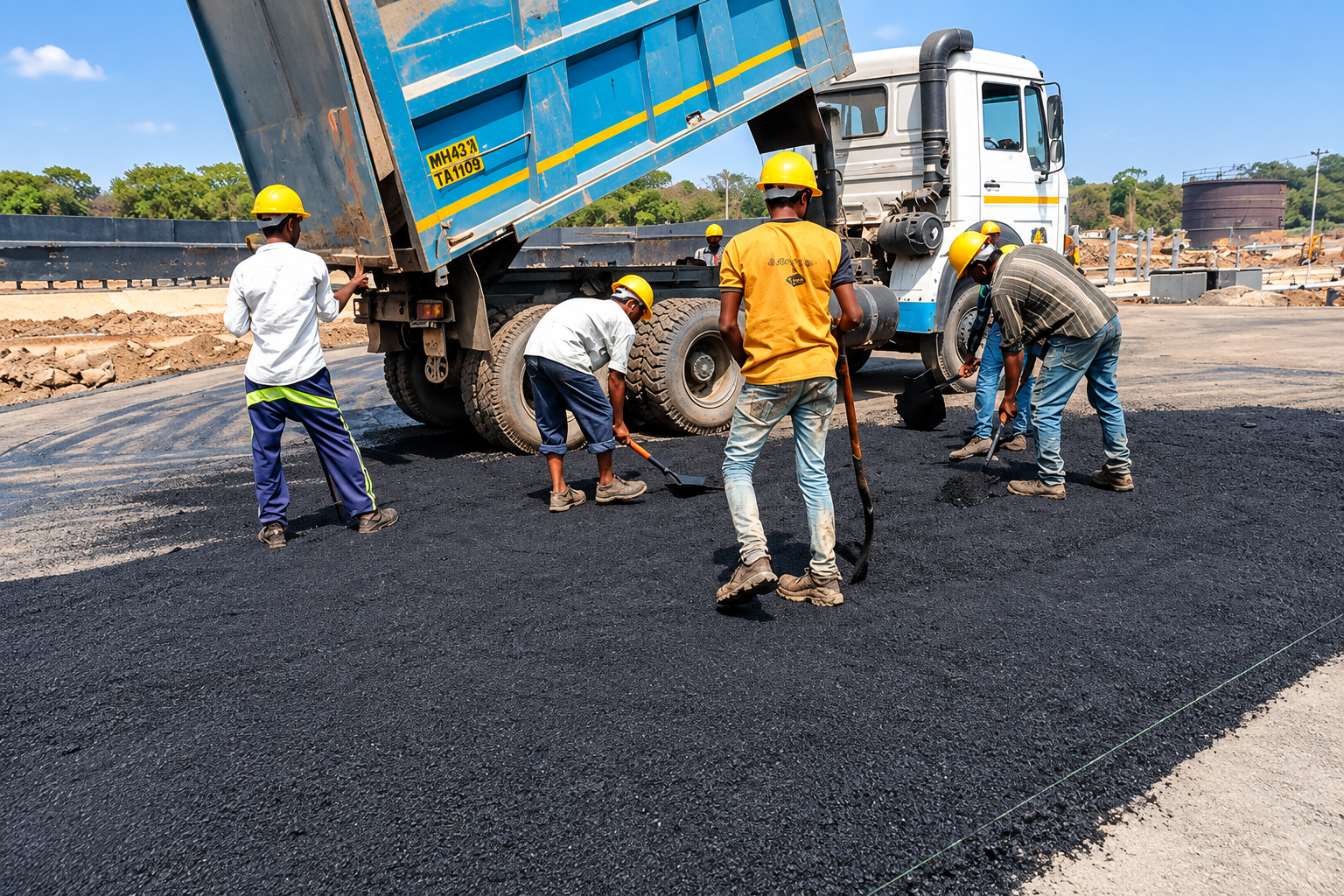
Material may need to be excavated from one location, loaded into tippers, transported, placed elsewhere and prepared according to the project's requirements.
As the work progresses, different machines and teams have to move together.
If excavation moves faster than transportation, material can accumulate. If transportation is not coordinated with placement activities, other equipment may remain waiting. Grading and compaction also need to follow the progress of the formation.
For this reason, large-scale road earthwork is as much about coordination as it is about machinery.
Excavation and Embankment Development
Natural ground rarely matches the exact levels required for road infrastructure.
Some sections may require excavation, while others may need filling and embankment development.
Managing these differences is an important part of road civil construction.
Our experience in excavation, earthwork and embankment-related activities allows us to support the early stages of road and highway development.
For us, the objective is straightforward: prepare the ground so that the next stage of the project has the formation it requires.
Sub-Grade: The Part of the Road You Don't See
Once a road is completed, the sub-grade is hidden from view.
That does not make it unimportant.
Sub-grade preparation is part of creating the formation on which subsequent road construction takes place. It can involve achieving the required levels, grading and compaction according to project specifications.
Our documented experience on NH-166 includes sub-grade-related work alongside excavation, earthwork and embankment activities.
This combination has given our teams practical exposure to multiple stages of road groundwork rather than only one part of the process.
Machinery That Keeps Road Civil Works Moving
Road construction often extends across long working stretches, which makes equipment planning particularly important.
Our machinery resources include Poclain excavators, Tata Hyva tippers, graders, vibratory rollers, water tankers and tractor loaders, along with supporting vehicles and equipment.
Each has a different role on the ground.
Excavators can support excavation and loading. Tippers move material. Graders assist with formation and levelling. Vibratory rollers support compaction, while water tankers and other equipment contribute to supporting site activities.
But simply having machines on site is not enough.
They need to work as part of a coordinated operation.
The People Keeping the Site Moving
Behind the equipment is an experienced workforce.
Our team includes project managers, site engineers, supervisors, equipment operators, drivers, helpers and supporting personnel.
Road projects can involve activities taking place at several locations along the same construction stretch. This makes communication between site teams particularly important.
Operators need to know where equipment is required. Drivers need clarity on material movement. Supervisors need visibility of daily activities, while engineers and project managers coordinate the broader requirements of the work.
This everyday coordination is one of the less visible but essential parts of civil construction.
Road Construction Around a Growing Navi Mumbai
Navi Mumbai continues to develop as an important residential, commercial, industrial and transportation region.
As development expands, road connectivity and supporting infrastructure remain fundamental to how different areas function together.
Our experience in the region includes work associated with CIDCO as well as material transportation related to Navi Mumbai International Airport.
Combined with our broader highway and expressway experience across Maharashtra, this gives us an understanding of both local infrastructure activity and the demands of larger transportation projects.
What Should You Look for in a Road Civil Works Contractor?
Choosing a road civil works contractor in Navi Mumbai should involve more than comparing quotations or looking at an equipment list.
Relevant project experience matters.
A contractor involved in road groundwork should understand earthwork operations, excavation, material movement, embankment development and sub-grade preparation. Equally important is having the machinery and manpower required to coordinate these activities on site.
Major road construction is a sequence. When one activity is poorly coordinated, it can affect the work that follows.
Experience helps a contractor understand these connections.
Building Roads from the Ground Up
At Godavari Constructions, our association with civil contracting goes back to 1978, followed by the establishment of Godavari Constructions in 1989.
Since then, our work has taken us across different infrastructure environments and helped us develop practical capabilities in road civil works, highway earthwork, excavation, embankment, sub-grade preparation and material movement.
We know that the part of a road people eventually drive on is only the final result of a much longer construction process.
Our work begins earlier — with the ground beneath it.
For road, highway and infrastructure projects requiring an experienced road civil works contractor in Navi Mumbai, Godavari Constructions brings together decades of civil contracting experience, construction machinery and people who understand the realities of working on site.
Service
|
06 Oct 2026