Enquiry
Heavy Civil Construction Contractor in Maharashtra
Heavy civil construction is different from ordinary construction. The projects are larger, the ground conditions can be more demanding, machinery plays a bigger role, and every stage requires careful coordination between people, equipment and site operations.
A highway cannot move forward without properly prepared ground. An expressway requires large quantities of earth to be excavated, transported, placed and compacted. Railway formation work demands systematic site execution. Even material movement for a major infrastructure development can become a significant operation in itself.
This is the environment in which we have built our experience at Godavari Constructions.
Our roots in civil contracting go back to 1978, when our promoter, Shri Dilip Marutirao Tidke, began working in the industry. Godavari Constructions was established in 1989, and since then, our journey has taken us across different infrastructure projects in Maharashtra.
Today, that experience forms the foundation of our work as a heavy civil construction contractor in Maharashtra.
What Makes Heavy Civil Construction Different?
Heavy civil construction generally involves infrastructure projects where the scale of work, quantity of material and equipment requirements are significantly larger.
Earthwork is a good example.
On a major road or expressway project, earthwork is not simply about digging soil. The process can involve excavation, loading, transportation, filling, embankment formation, grading and compaction before the next construction stage can proceed.
Every activity affects another.
If excavation falls behind, transportation can be affected. If material movement is not coordinated properly, machinery can remain idle. If ground preparation is not carried out according to project requirements, subsequent work can face difficulties.
This interconnected nature of the work makes planning and site coordination particularly important.
Experience Built on Major Infrastructure Projects
Our understanding of heavy civil construction has developed through actual infrastructure assignments rather than theory alone.
Godavari Constructions' documented project portfolio includes work associated with the Mumbai–Nagpur Expressway, where our scope involved a section between Km 498.000 and Km 501.400.
Our experience also includes earthwork, excavation, embankment and sub-grade-related work associated with NH-166 Ratnagiri–Kolhapur.
Beyond highways, we have undertaken railway formation work and material loading and transportation activities related to Navi Mumbai International Airport.
Our portfolio also extends to irrigation-related civil works and other infrastructure assignments.
Working across different sectors has helped our teams understand one important reality: every large project behaves differently once work begins on the ground.
Earthwork at Scale
Earthwork is one of the areas where the difference between general construction and heavy civil construction becomes particularly visible.
Large infrastructure projects can require substantial quantities of soil, rock and other materials to be excavated or moved.
This requires more than equipment.
Haul routes need to be considered. Excavators and tippers need to work in coordination. Material needs to reach the required location without unnecessarily slowing other site activities. Grading and compaction then need to follow according to the requirements of the project.
Our experience with excavation, embankment development, sub-grade preparation and bulk material movement allows us to approach this work as part of a complete site operation rather than as isolated activities.
Machinery That Supports Heavy Civil Work
Heavy civil construction depends heavily on having appropriate equipment available for different stages of execution.
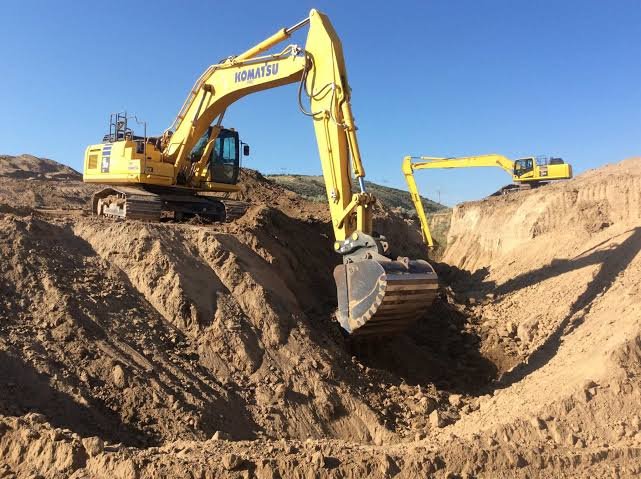
Our machinery resources include Poclain excavators, Tata Hyva tippers, graders, vibratory rollers, water tankers and tractor loaders, together with supporting vehicles and equipment.
Each machine serves a practical purpose.
Excavators support digging and loading operations. Tippers help move material across and between project locations. Graders assist in achieving the required formation, while rollers support compaction activities.
However, owning machinery alone does not make a contractor capable of handling heavy civil work.
The real challenge is deploying equipment efficiently according to site conditions and project requirements.
The Team Behind the Machinery
There are people behind every machine and every day's progress on a construction site.
Our workforce includes project managers, site engineers, supervisors, equipment operators, drivers, helpers and other supporting personnel.
Their roles are different, but their work is connected.
Project managers and engineers coordinate requirements and progress. Supervisors remain close to daily site activities. Operators and drivers keep machinery and material movement functioning on the ground.
This combination of manpower and machinery is particularly important on large civil projects where several activities may be taking place simultaneously.
Working Across Different Conditions in Maharashtra
Maharashtra presents contractors with very different working environments.
A road project in one region may involve completely different terrain and logistical challenges from an infrastructure project elsewhere in the state.
Over the years, our project experience has taken us across locations including Navi Mumbai, Raigad, Ratnagiri and Kolhapur, among others.
Working in different environments has strengthened our understanding of site execution.
It has also taught us that heavy civil construction cannot depend on a single standard approach. Every project needs to be understood according to its own ground conditions, quantities, timelines and operational requirements.
Heavy Civil Construction Is Ultimately About Coordination
Large equipment may be the most visible part of heavy construction, but coordination is what keeps a project moving.
Machinery needs fuel and maintenance. Operators need clear instructions. Material movement needs suitable routes. Engineers and supervisors need visibility of site progress. Different activities need to happen in the correct sequence.
When these elements are coordinated effectively, the site functions as one operation rather than a collection of separate activities.
At Godavari Constructions, this practical understanding has been developed over decades of working in civil construction.
Building the Groundwork for Maharashtra's Infrastructure
Maharashtra continues to invest in highways, expressways, transportation networks, industrial development and other major infrastructure.
Much of that development begins with work that eventually disappears beneath the finished project.
The excavation is covered. The embankment becomes part of the road. The prepared formation supports infrastructure that may remain in service for years.
That is the nature of heavy civil construction.
The work beneath the surface may not always remain visible, but the infrastructure above it depends on how that work was carried out.
Looking for a Heavy Civil Construction Contractor in Maharashtra?
When selecting a heavy civil construction contractor in Maharashtra, it is important to consider the contractor's experience with large infrastructure environments, earthwork operations, machinery deployment, material movement and on-site coordination.
At Godavari Constructions, our civil contracting roots go back to 1978, with the company established in 1989. Our project experience across expressways, highways, railway formation, airport-related material transportation, irrigation and other civil works has helped us build practical capabilities for demanding infrastructure projects.
For projects involving large-scale earthwork, excavation, embankment construction, sub-grade preparation, road and highway civil works, bulk material movement or other heavy infrastructure activities, we bring together experienced people, construction machinery and decades of knowledge gained on actual project sites.
Service
|
30 Sep 2026